
Here’s a comprehensive overview of Hazard Identification and Risk Assessment (HIRA)—a fundamental and highly searchable workplace safety topic:
🔍 Hazard Identification and Risk Assessment (HIRA)
✅ Definition
HIRA is a structured process used to identify hazards, analyze or evaluate the risk associated with those hazards, and then determine appropriate ways to eliminate or control the risk.
📌 1. Key Elements of HIRA
| Element | Description |
|---|---|
| Hazard | Anything with the potential to cause harm (e.g., chemical, mechanical, electrical, physical, ergonomic, biological). |
| Risk | The likelihood that a hazard will cause harm and the severity of that harm. |
| Risk Assessment | Process of evaluating risk based on likelihood and severity. |
| Control Measures | Actions to eliminate or minimize risks (e.g., engineering controls, PPE, training, safe work procedures). |
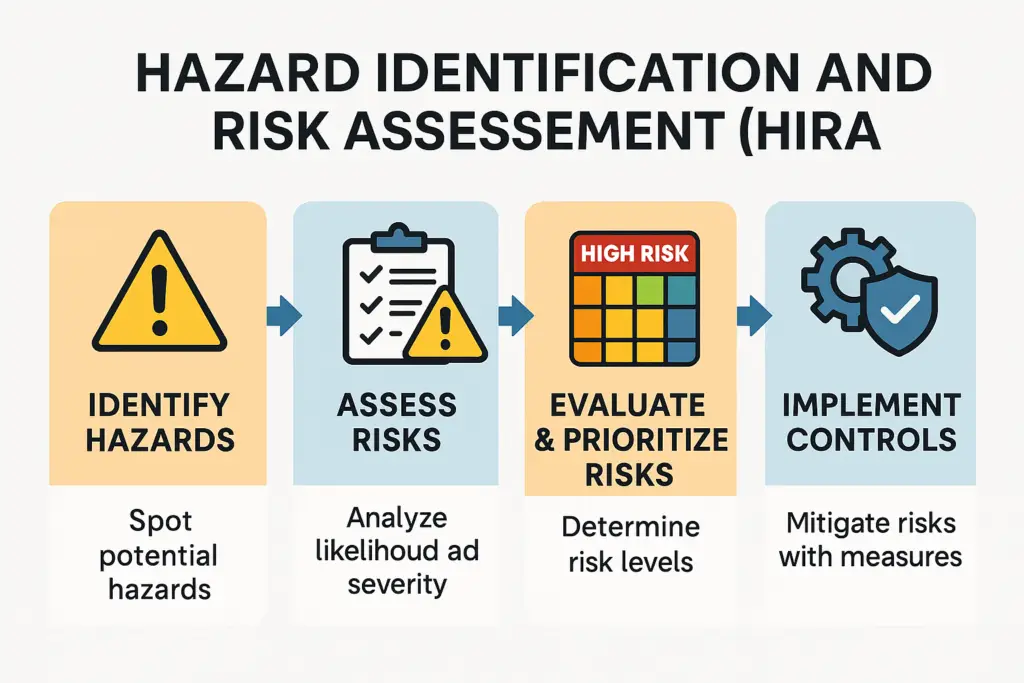
🛠️ 2. HIRA Process Steps
Identify Hazards
Observe the workplace
Review incident reports
Conduct job safety analysis (JSA)
Engage workers in walkthroughs
Assess Risks
Evaluate likelihood and severity
Use a risk matrix (e.g., 5×5 scale)
Evaluate & Prioritize Risks
Classify risks: Low, Medium, High, Extreme
Focus on high-priority risks first
Implement Controls
Apply the Hierarchy of Controls:
Elimination
Substitution
Engineering Controls
Administrative Controls
PPE
Review and Monitor
Regular review of risks
Update based on changes in process, equipment, or incidents
📊 3. Risk Matrix (Example: 5×5 Grid)
| Catastrophic | Major | Moderate | Minor | Negligible | |
|---|---|---|---|---|---|
| Certain | High Risk | High Risk | High Risk | Medium Risk | Medium Risk |
| Likely | High Risk | High Risk | Medium Risk | Medium Risk | Low Risk |
| Possible | High Risk | Medium Risk | Medium Risk | Low Risk | Low Risk |
| Unlikely | Medium Risk | Medium Risk | Low Risk | Low Risk | Very Low Risk |
| Rare | Medium Risk | Low Risk | Low Risk | Very Low | Very Low Risk |
🧩 4. Types of Hazards in HIRA
| Hazard Type | Examples |
|---|---|
| Physical | Noise, vibration, radiation, heat |
| Chemical | Acids, solvents, gases, dust |
| Biological | Bacteria, viruses, fungi |
| Ergonomic | Repetitive motion, poor posture |
| Mechanical | Unguarded machinery, moving parts |
| Electrical | Live wires, arc flash risk |
| Psychosocial | Stress, harassment, fatigue |
📘 5. Legal and Standard References
ISO 45001:2018 – Clause 6.1.2 (Hazard Identification & Assessment of Risks and Opportunities)
Factories Act (India) – Sections 7A & 41A
OSHA 29 CFR 1910 (USA)
BOCW Act – Rule 39 (Safety Officers)
🧠 6. Practical Uses of HIRA
Preparing Method Statements
Conducting Safety Walkdowns
Planning Work Permits (Hot work, Confined Space, etc.)
Developing Emergency Response Plans
Enhancing Training Programs
Would you like:
A HIRA template in Excel/Word?
A presentation format for training?
An activity-specific HIRA (e.g., scaffolding, excavation, electrical work)?
Or a HIRA register sample?